Syracuse University:
Syracuse donor relations bet its credibility on one decision
“We're thinking a lot more like strategists than people who write impact reports. Now we can integrate ourselves where we couldn't before.”
The FOMO was real
Syracuse University's donor relations team knows how a good conference usually ends.
“I've attended so many conferences where I was excited to learn, but I'd come home disappointed because we couldn't do it. We just didn't have the bandwidth, didn't have the tools... It's good to know people in our field are doing great things. Not us, though.”
This year was different. They came home ready to do it.
For years, stewardship at Syracuse meant choosing between depth and reach. A handful of donors got a beautifully written, bespoke impact report. Everyone else got dry financials, maybe a student profile or a thank-you, and most got nothing at all.
“I remember asking, how many reports did we do this year? I think the answer was nine. They were really well done, really well written. But how could you possibly replicate that attention to detail for so many more people? It was ad hoc forever, a cycle of ad hoc we just couldn't get out of,” said Brittany Hoffman Smith, Associate Director of Stewardship and Donor Relations, Syracuse University.
Those nine reports took up roughly 80% of Brittany's time. Meanwhile, the endowment report covered close to 3,000 endowments.
“We've been doing them in print for so long that it just seemed insurmountable. We've done them digitally lots of different ways, and none of them gave us the full opportunity to tell the story. It's just dry financials that don't land the way we want them to,” said Jess Finley, Executive Director of Donor Relations, Syracuse University.
The problem was never effort
Syracuse's donor relations team knew what best in class looked like. They had spent years priming donors for it. What they didn't have was the infrastructure to deliver it across a university with more than 130 gift officers.
“We've been too small of a team for too big of a school. We're a central unit that's supposed to do everything and be the experts on everything. It's really hard to spend your entire career telling people we don't have the bandwidth. I've written a thousand proposals that went nowhere.”
When donor relations couldn't keep up, the work went elsewhere, and something got lost along the way.
“So we just kind of had this…well, donor relations can't do it, they don't have the bandwidth, they're understaffed, so we're going to hire somebody. And then they're hiring somebody to send something out that's not donor centered. It might be pretty, but it didn't come from us. It wasn't our voice.”
How they made the case (nine years to a yes!)
The team first met Mythos at a conference almost a decade ago and picked it as their clear choice early on. Convincing leadership took much longer. For a while, leadership thought Syracuse could build something homegrown.
“The drawback of a homegrown system is that you have to maintain it. You have to be the customer service representative. You have to be the technical people. You have to be everyone, all the time. I'm not any of those things. I'm a subject matter expert in donor relations.”
Brittany also kept the idea in front of colleagues. Every Mythos promotional mailer that arrived went up on a corkboard cubicle wall, one after another, until the board was full and people started to stop and ask what it was all about. Years later, when Brittany told a campus partner the team was onboarding a new platform, the partner asked, “Is it Mythos?” She already knew Mythos, and couldn't wait to work with it. Brittany still wonders whether she walked past that corkboard.
The case that finally won leadership over came down to four points:
- Go digital without losing print. Syracuse still has print donors, and Mythos handles both.
- Use one platform well beyond the endowment report: impact reports, landing pages, acknowledgments, and eventually proposals.
- Break down silos by bringing gift officers, deans, and campus impact narrators into the same platform.
- Staffing math. "The amount it would have cost us in staff to do what we're going to be able to do is not possible, nor would we have been able to train that many people."
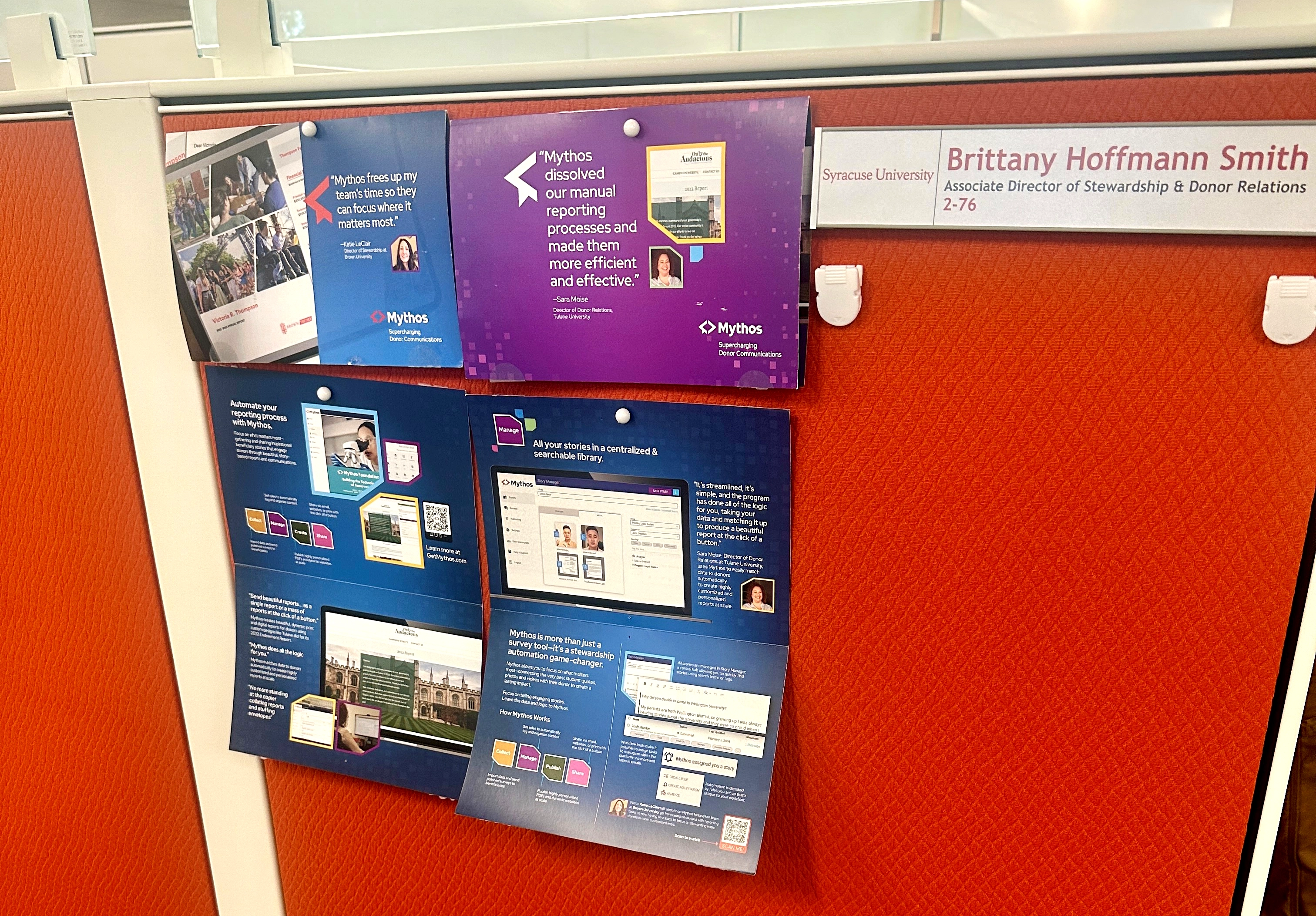
Brittany displayed every mailer outside her cubicle as it arrived. It got the attention of team members.
Building the plane with a co-pilot
Early on, Brittany had asked the Mythos team what a typical onboarding looked like. The answer was “we’ll meet you where you’re at.” Now that promise was being tested. She took the problem straight to them. “I have to get this done by the end of the month. We need to speed something up, or teach me faster.” The answer that came overnight was “no problem!”
Within a couple of days, Sara Moïse, Mythos Chief Stewardship Advocate, had built a full template with Brittany's content already in place. Brittany checked it, swapped a few photos, and learned the platform while it was being built around and for her and her process.
“It was very nice to have somebody with a donor relations background working alongside me, knowing how the content needed to be written for a donor audience. I still met my deadline.”
The team had planned static sites and PDFs for year one. The thinking was that keeping it simple would allow them to ramp up faster and they could always evolve and enhance what they are doing in year two. Once they saw that dynamic sites took the same setup time, they decided to skip ahead. In their words, they under-promised and over-delivered.
“We've not been told no. We throw an idea out, and every single time it's 'absolutely, we can do that.' That's music to our ears.”
And their ideas keep getting bigger. “Ideas are like five times bigger than they’ve ever been before.” An idea that comes up in a morning meeting is often built by the end of the day. When scholarship students needed to understand why their survey responses mattered, the team built a site that told them about the donors behind their support. Landing pages that were never part of the plan, video included, now take minutes. “The more I use it, the faster I am,” Brittany said.
What's next
Syracuse is building its first digitally delivered endowment report now, followed by scholarship recipient updates and a spring impact report as a second touch. Gift officers and assistant deans are getting sneak peeks so they can walk donors through their reports with confidence.
One donor already told the team last year’s report was the best information he had ever received from Syracuse. Their answer was “just wait”.